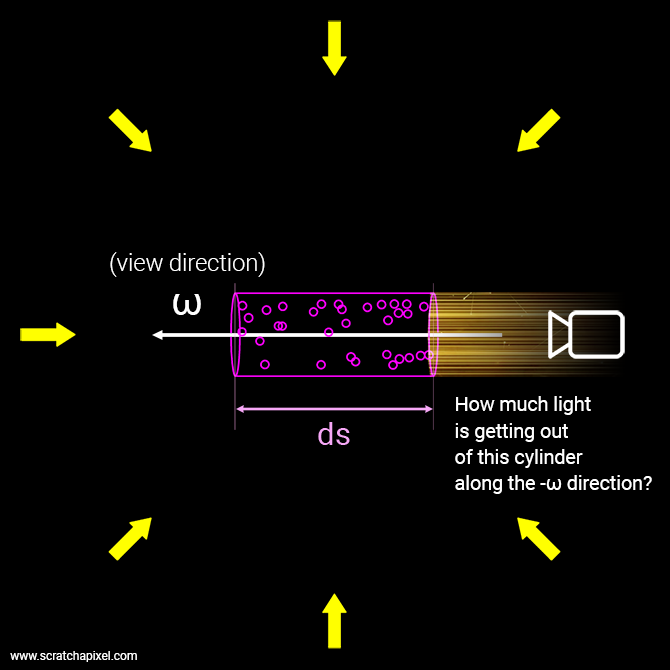
When traveling through a volume, light interacts with it, resulting in a change in radiance
Change in radiance [math]dL[/math] along [math]ds[/math]:
[math]dL(x, \omega) = L_o(x, \omega) – L_i(x, \omega) = \text{emission} + \text{in-scattering} – \text{out-scattering} – \text{absorption}[/math]
- Radiance [math]L[/math]: intensity of the light beam after it has traveled through the volume
- Incoming radiance [math]L_i[/math]: intensity of light shone on the cylinder
- Outgoing radiance [math]L_o[/math]: how light much leaves the volume on the other end
- View direction [math]\omega[/math]: camera ray direction
Light/Medium Interactions
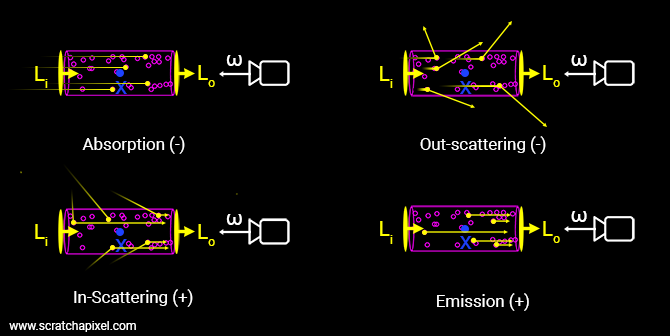
- Radiance decreasing interactions
- Absorption: some of the light is absorbed
- Out-scattering: photons making up the light beam traveling towards the eye are scattered in another direction
- Radiance increasing interactions
- In-scattering: some of the light is redirected towards the eye
- Emission: medium emits light, electrons gain energy released in the form of photons. Directions taken by these photons are random but some of them will travel towards the eye
Absorption (Beer-Lambert Law)
Internal transmittance: amount of light absorbed by the volume as light travels a certain distance through it
[math]T = e^{- \text{distance} \cdot \sigma_a}[/math]
- [math]T=0[/math]: volume blocks all light; [math]T=1[/math]: all light transmitted
- Absorption coeffcient [math]\sigma_a[/math]: the denser the volume, the higher the absorption coefficient
- Colour that we see when looking at a surface with colour [math]c_s[/math] through a volume with colour [math]c_v[/math] is given by:
[math]C = T \cdot c_s + (1 – T) \cdot c_v[/math]
Out-scattering
Light initially traveling towards the eye through a volume interacts with particles in the volume, changing its direction
In-scattering
Light passing through a volume is redirected toward the eye due to a scattering event
- In-scattering can happen anywhere between [math]t_0[/math] and [math]t_1[/math]
- Amount scattered toward the eye’s direction [math]\omega[/math] where [math]x[/math] is a point on the segment [math]t_0[/math] to [math]t_1[/math]:
[math]\int_{x=t_0}^{t_1} L_i(x, \omega) dx[/math]
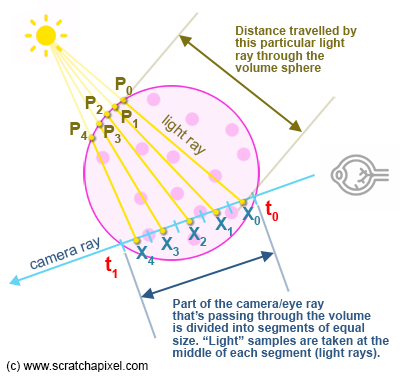
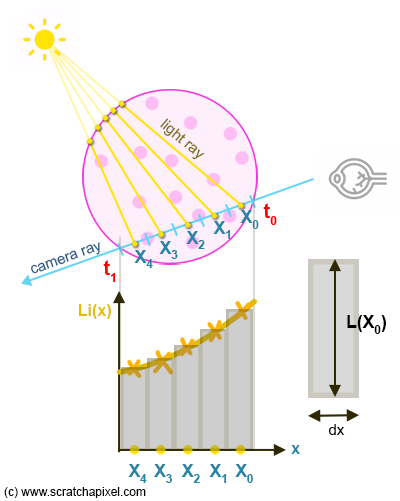
No analytical solution -> approximate through Riemann’s sum:
For each segment [math]dx[/math]:
- Shoot a ray from [math]x[/math] (middle of subsegment) towards light source to get the distance light has traveled through the volume between light source and [math]x[/math]
- Beer’s law gives amount of light [math]L_i(x, \omega)[/math] arriving at [math]x[/math]
- Multiply [math]L_i(x, \omega)[/math] by [math]dx[/math] and accumulate the contribution
Two things missing:
- We dont know what fraction of light is actually being in-scattered
- The in-scattered light will also be absorbed on it’s way back to the eye
Coefficients
Absorption coefficient [math]\sigma_a[/math]
Absorption increases whether you double either the absorption coefficient or the distance traveled by the light through the volume
Scattering coefficient [math]\sigma_s[/math]
In-scattering and out-scattering are part of the same scattering phenomenon -> proba that a photon is being scattered is the same and defined by single coefficient
Extinction coefficient [math]\sigma_t[/math]
[math]\sigma_t = \sigma_a + \sigma_s[/math]
Out-scattering and absorption both result in loss in radiance -> combine them when calculating this loss -> extinction or attenuation coefficient
- They all represent probability densities: likelihood that a random event (ex: absorption event) occurs at a given point
- Unit: reciprocal distance, inverse of a distance
- Mean free path: average distance a photon will travel through a volume before the photon and the medium interact with one another, inverse of the coefficient